No products in the cart.

WordPress SEO Agency: How to Choose the Right One in 2026-2027

Type “WordPress SEO agency” into Google and you’ll get thousands of results — most of them agencies telling you they’re the best choice. Every one of them promises rankings, traffic, and leads. Almost none of them explain how to tell a good agency from a mediocre one before you’ve signed a contract and spent three months waiting on results that never show up.
This guide skips the sales pitch. It covers what a WordPress SEO agency actually does, why WordPress SEO isn’t quite the same as general SEO, a practical checklist for vetting agencies, the red flags that should make you walk away, and what’s actually changed now that Google AI Overviews and tools like ChatGPT are part of how people search.
If you’re deciding whether to hire help at all, or you’ve already got a shortlist and need to pick one, this should get you there faster.
What Does a WordPress SEO Agency Do?
A WordPress SEO agency is a search engine optimization provider that specializes in the WordPress platform specifically — its themes, plugins, page builders, database structure, and the technical quirks that come with running a CMS that powers a huge share of the web.
In practice, that usually covers:
- Technical SEO — crawlability, indexing, site speed, Core Web Vitals, structured data
- On-page SEO — keyword targeting, title tags, headings, internal linking, content structure
- Content strategy — figuring out what your customers actually search for and building pages that answer it
- Authority building — earning the links and mentions that establish trust with Google
- Reporting — tracking rankings and traffic, and ideally, leads or revenue, not just vanity metrics
The good ones don’t stop at “more traffic.” They build toward qualified traffic — visitors who are actually likely to become customers — because that’s the number that pays your bills, not your keyword rankings.
Why WordPress Needs a Different Kind of SEO
WordPress runs a huge share of the web — by some estimates, over four in ten websites — which is exactly why generic SEO advice doesn’t always translate cleanly to it. The principles of SEO don’t change by platform. What changes is how you execute them inside WordPress’s specific architecture.
A few things that are unique to the platform:
- Themes and page builders can quietly wreck your Core Web Vitals. Tools like Elementor and Divi are great for design flexibility, but they generate bloated code if they’re not configured carefully — which slows down Largest Contentful Paint and Interaction to Next Paint, two metrics Google uses to judge page experience.
- Plugins conflict with each other. Two SEO plugins running at once, or a caching plugin fighting with a security plugin, can quietly create duplicate meta tags, broken schema, or pages that don’t render the way Google sees them.
- Categories and tags create duplicate content if they’re left unmanaged, since WordPress generates a separate archive page for every single one by default.
- Database bloat from years of post revisions, spam comments, and leftover plugin data can slow down even a well-designed site.
None of that gets fixed by installing a plugin and reading a “top 10 SEO tips” article. It’s the kind of thing a WordPress SEO agency deals with daily — and the kind of thing a generalist agency might not even know to look for.
6 Signs You Need to Hire a WordPress SEO Agency
Not every WordPress site needs outside help. But if any of these sound familiar, it’s usually a sign that DIY SEO has hit its ceiling:
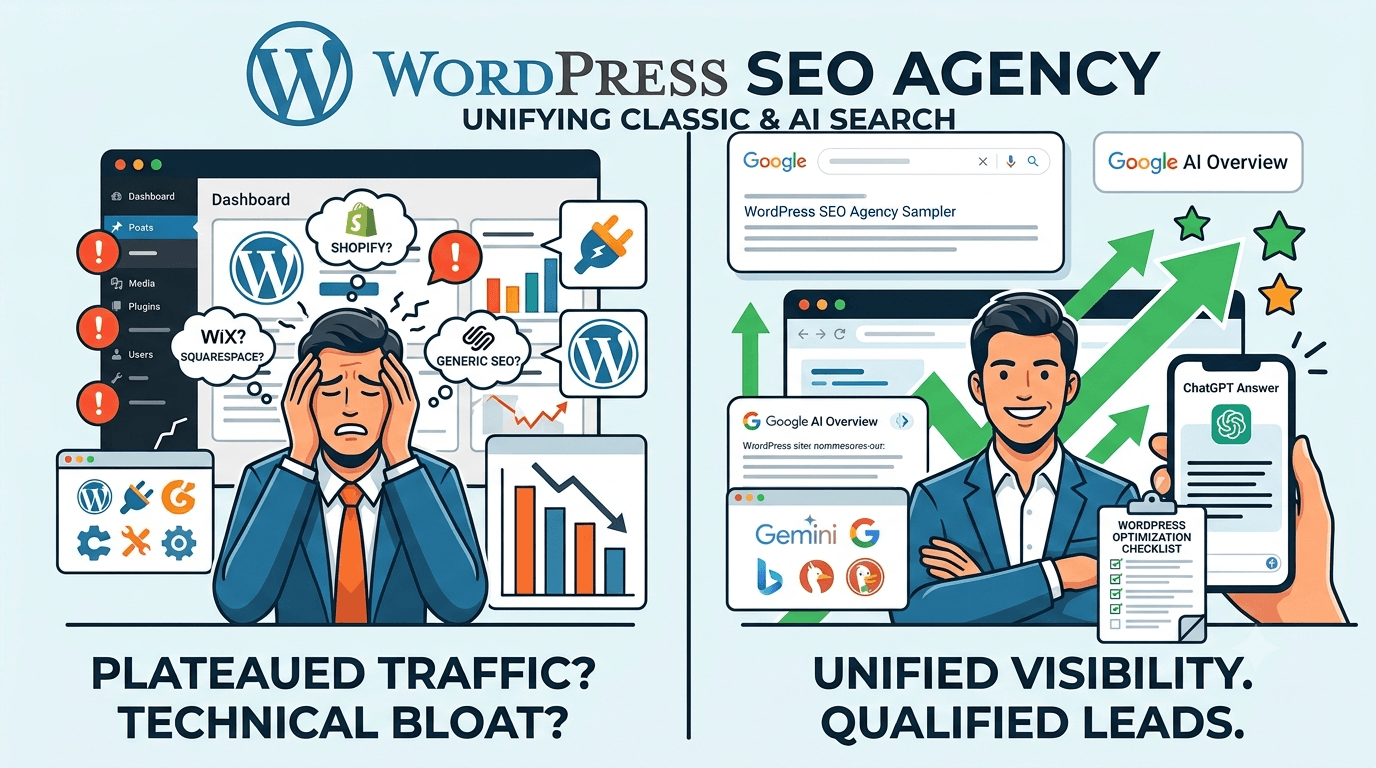
- Your traffic has plateaued or is slipping, even though you’re still publishing content.
- Your site is slow, especially on mobile, and you’re not sure why.
- You migrated to WordPress — from Wix, Squarespace, Shopify, or a custom build — and rankings dropped afterward.
- You’re ranking for keywords that don’t convert, while the ones that would actually bring in customers stay out of reach.
- Nobody on your team has time to keep up with algorithm updates, technical maintenance, and content at the same time.
- Competitors are showing up in Google AI Overviews and AI answers, and you’re not — even for searches you’d expect to win.
If two or more of these apply, it’s worth getting a second opinion. A free WordPress SEO audit will usually tell you within a day or two whether the problem is something small you can fix yourself or something that needs ongoing expertise.
How to Choose the Right WordPress SEO Agency: A 6-Point Checklist
This is the part that actually matters. Here’s what to check before you sign anything.
1. Ask for WordPress-specific proof, not generic screenshots
Any agency can show you a traffic graph going up and to the right. Ask specifically about WordPress projects: what plugins and themes were involved, and what technical issues did they actually fix. If they can’t get specific, they’re probably not WordPress specialists — they’re a general SEO shop that happens to take WordPress clients too.
2. Confirm they audit before they quote
A legitimate WordPress SEO agency looks at your site before proposing a strategy or a price. If an agency hands you a package price before ever seeing your website, that number is based on guesswork, not on your actual problems.
3. Check their own technical health
Before you hire anyone to fix your Core Web Vitals, run their website through Google PageSpeed Insights. An agency that can’t keep its own WordPress site fast and clean isn’t the one to fix yours.
4. Get specific about reporting
Ask exactly what you’ll see in monthly reports, and how often. Rankings and traffic are useful, but they should also track leads, calls, or sales — the numbers that actually justify the spend. If “reporting” means a spreadsheet of keyword positions and nothing else, keep looking.
5. Ask how they handle AI search visibility
This is newer ground, and it separates agencies that are paying attention from ones that aren’t. Ask directly: how do you approach visibility in Google AI Overviews and AI chat tools? A good answer sounds like solid fundamentals — content quality, technical health, credibility signals. A concerning answer sounds like a checklist of gimmicks with no substance behind it (more on that below).
6. Understand exactly what you’re paying for
WordPress SEO pricing ranges from a few hundred dollars a month to five-figure enterprise retainers, and the number alone won’t tell you much. Ask what’s actually included — audit scope, content volume, link building, reporting cadence — before comparing price tags across agencies. If it helps to see what a structured engagement looks like end to end, our WordPress SEO process breaks down exactly what happens at each stage, from audit through ongoing growth.
Red Flags: What a Bad WordPress SEO Agency Looks Like
A few warning signs are worth calling out on their own, because they show up constantly in this industry:
- Guaranteed rankings. Nobody controls Google’s algorithm, including Google’s own engineers. Any agency promising a #1 ranking by a specific date is either inexperienced or not being straight with you.
- No audit, no questions, just a quote. If they can price a strategy without ever looking at your site, the number is arbitrary.
- Vague reporting, or none at all. “Trust the process” isn’t a reporting strategy.
- One strategy for every client. A five-page local business site and a 500-page e-commerce catalog need completely different approaches. A templated pitch usually means a templated strategy.
- Backlink packages sold by the thousand. Cheap, bulk link building is one of the fastest ways to get a WordPress site penalized instead of ranked.
- Reluctance to explain their process. If an agency can’t or won’t explain what they’re actually doing to your site in plain language, that’s reason enough to walk away.
Most bad agencies reveal themselves in the first conversation, before any contract gets signed.
Can a WordPress SEO Agency Help You Show Up in Google AI Overviews and ChatGPT?
This is the question every business is asking right now — and it’s also where a lot of agencies are overselling.
In May 2026, Google published its first official guidance on optimizing for AI Overviews and AI Mode, and the core message surprised a lot of the SEO industry: there are no special extra requirements to appear in these AI features. No dedicated AI file to create. No special schema you’re missing out on. According to Google’s own documentation, a page just needs to meet the same bar as classic search — indexed, crawlable, and eligible to show a normal snippet.
What Google does say still matters:
- Crawling allowed in robots.txt, with nothing blocking access
- Solid internal linking so important pages are easy to find
- A genuinely good page experience — speed, stability, mobile usability
- Important content available as real, readable text, not locked inside an image or a script
- Structured data that actually matches what’s visible on the page, not stuffed in for its own sake
In other words, the businesses showing up in AI Overviews aren’t the ones that found a secret formatting trick. They’re the ones with a technically clean WordPress site and genuinely useful content — the same things a competent WordPress SEO agency should already be doing.
That’s also a reason to be skeptical of any agency selling “GEO packages” built around gimmicks — special AI text files, aggressive schema stuffing, content rewritten specifically to sound “AI-friendly.” None of that is required, according to Google’s own guidance, and some of it edges toward the kind of manipulative content their spam policies actively discourage. The agencies actually winning AI visibility right now are treating it as an extension of solid SEO, not a separate discipline with its own shortcuts.
How Much Does a WordPress SEO Agency Cost?
Pricing varies a lot depending on what “WordPress SEO” actually includes in your case. A one-time technical audit is a different investment than an ongoing monthly retainer covering content, link building, and reporting.
Broadly, expect to see three pricing models:
- Project-based or audit-only — a fixed fee to diagnose and fix specific technical issues, with no ongoing commitment
- Monthly retainer — the most common option for growing businesses, covering continuous technical monitoring, content, and authority building, with scope and price scaling to site size and competition
- Custom or enterprise engagements — larger sites, e-commerce catalogs, or multi-location businesses usually need a tailored scope rather than a fixed package
Price alone is a poor way to compare agencies. A cheap retainer that skips technical work or outsources content to the lowest bidder usually costs more in the long run — in lost time and lost rankings — than a properly scoped engagement would have. See our current pricing packages for exact numbers and what’s included at each tier.
Why Businesses Choose AI POTLINE as Their WordPress SEO Agency
Plenty of agencies can install an SEO plugin, publish a few blog posts, and call it done. Fewer combine WordPress-specific technical fixes with content built around real search intent — and fewer still are actively building for how AI Overviews, ChatGPT, and Gemini surface answers, on top of classic Google results.
That’s the approach we take. Every engagement starts with a full technical and content audit of your WordPress site, not a generic template, so the fixes and strategy actually match what’s holding your rankings back. From there, the WordPress SEO process we follow combines technical cleanup, on-page and content optimization, and authority building into one connected strategy instead of treating them as separate line items.
If your needs go beyond SEO — a website rebuild, PPC, reputation management, or a fuller digital marketing plan — that’s covered under our full digital marketing services too, so you’re not stitching together three different vendors.
We don’t sell ranking guarantees, because nobody legitimately can. What we do commit to is a clear process, honest reporting, and a strategy built around your actual business goals, not just keyword positions.
Frequently Asked Questions
What does a WordPress SEO agency do?
A WordPress SEO agency improves how well a WordPress website performs in search results by combining technical fixes — speed, crawlability, Core Web Vitals — with on-page optimization, content strategy, and authority building, all tailored to how WordPress specifically works rather than generic, platform-agnostic advice.
How much does WordPress SEO cost per month?
Monthly WordPress SEO typically ranges from a few hundred dollars for smaller sites to several thousand for competitive or enterprise projects, depending on scope, content volume, and competition level. The exact fit depends on your site’s size and goals.
How long does WordPress SEO take to show results?
Most sites see measurable movement in rankings and traffic within 3 to 6 months, with stronger results building over 6 to 12 months. Timelines depend heavily on your site’s starting condition, how competitive your industry is, and how consistently the strategy is executed.
Is WordPress good for SEO?
Yes. WordPress is one of the more SEO-friendly platforms available, with clean, crawlable code, extensive plugin support (Yoast, Rank Math, and others), and full control over technical elements like URL structure and schema. That flexibility only helps if it’s configured correctly, which is where a lot of self-managed sites fall short.
What’s the difference between WordPress SEO and regular SEO?
The core principles are identical — relevance, authority, and user experience. The difference is execution: WordPress SEO deals with platform-specific issues like plugin conflicts, theme bloat, taxonomy duplication, and page-builder performance that simply don’t exist on other platforms.
Should I hire a WordPress SEO agency or handle it myself?
Basic on-page SEO is manageable in-house with tools like Yoast or Rank Math. Technical SEO, competitive content strategy, and authority building generally benefit from specialist experience, especially if you’re short on time or competing in a crowded market.
Can a WordPress SEO agency help my site show up in Google AI Overviews or ChatGPT?
Yes, though not through secret tricks. Per Google’s own 2026 guidance, there’s no special optimization required to appear in AI Overviews — it rewards the same fundamentals as classic SEO: crawlable, fast, well-structured, genuinely useful content. A WordPress SEO agency that understands this will build toward that, instead of selling you gimmicks.
The Bottom Line
A good WordPress SEO agency does two things well: it fixes what’s technically holding your site back, and it builds content and authority that actually brings in the right visitors — whether they find you through a classic Google result, an AI Overview, or a ChatGPT answer.
The wrong agency will happily take your money either way. The checklist above should make it a lot harder for that to happen to you.
If you’d rather skip the guesswork, book your free consultation and we’ll show you exactly what’s working on your site, what isn’t, and what it would take to fix it — no pressure, no generic pitch.